

Skills
Use Context Space skills as reusable operational guidance for agents.
Skills are reusable instruction packages discovered from SKILL.md files.
They are different from source documents. A source gives knowledge. A skill gives behavior.
Source vs skill
| Item | Purpose | Example |
|---|---|---|
| Source document | Ground the answer in content. | istanbul-guide.md, refund-policy.md, runbook.pdf |
| Skill | Tell the agent how to handle a class of tasks. | Trip planning rules, support escalation rules, incident review style |
In the travel guide sample, source documents contain city guide material. The trip planning skill contains instructions for how to build practical itineraries from that material.
Register a skill source
The discovery service looks for files named SKILL.md recursively under the skill source path.
Skill file format
The current parser expects YAML front matter followed by non-empty Markdown instructions.
How skills are used
When an agent uses a Context Space, Runiq discovers skills from attached skill sources. The active skills are added to the model instructions under Runiq Skills.
Skills are also emitted as stream events:
| Event | Meaning |
|---|---|
skill_loaded | Skill instructions were loaded for the run. |
context_provided | Context Space metadata, skills, and sources were attached. |
When to create a skill
Use a skill when the behavior should be reusable across agents or across many runs.
Good skill examples:
| Skill | Use |
|---|---|
| Travel planning | How to structure realistic itineraries. |
| Support escalation | When to escalate and how to phrase customer-safe answers. |
| Incident review | How to summarize timeline, impact, root cause, and follow-ups. |
| Policy review | How to compare a request against policy documents. |
| Sales discovery | How to ask structured qualification questions. |
Do not use a skill as a document dump. Put knowledge in sources. Put behavioral guidance in skills.
Studio preview
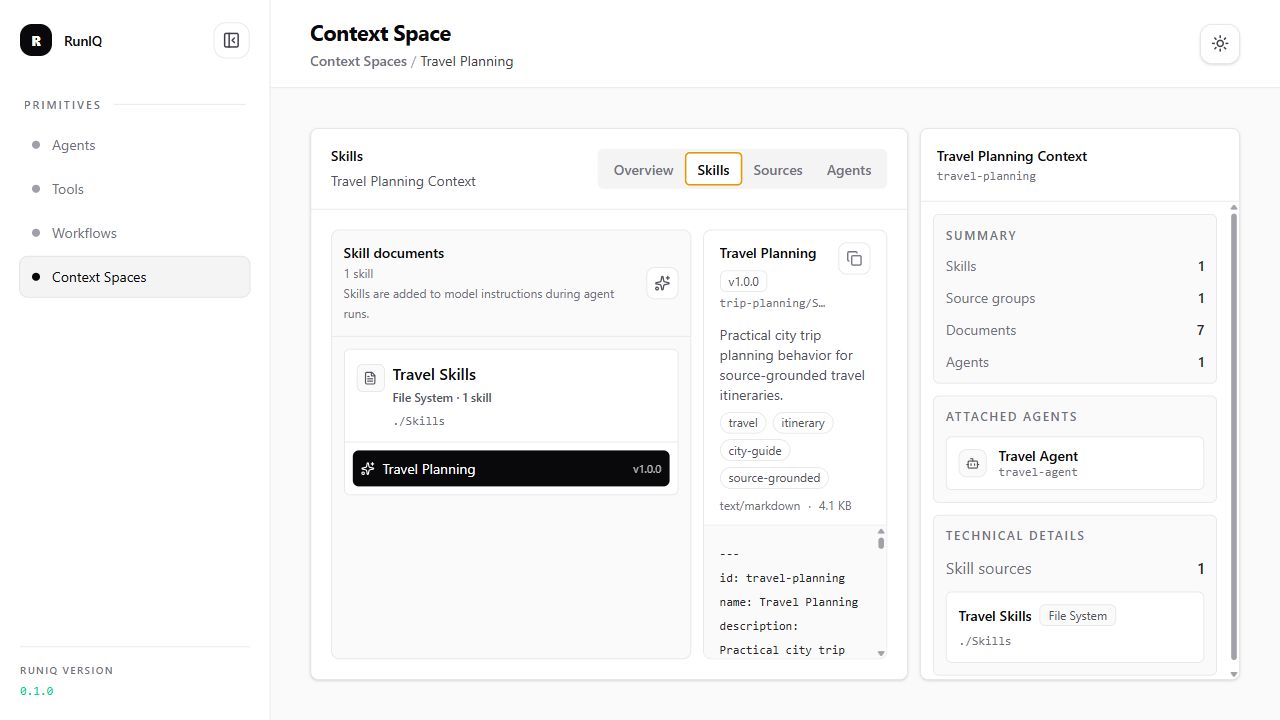
The dashboard shows the skills discovered from the skill source registered in code. In the example above, FromFileSystem(...) points Runiq at the ./Skills folder. Runiq scans that folder recursively and loads files named SKILL.md.
In context-skills-dashboard.png, the developer can inspect:
- the discovered skill package,
- the skill id, name, description, version, and tags,
- the file-system source path where the skill was found,
- the Markdown instructions that will be loaded for agent runs.
Skills are assigned through Context Spaces because they describe how agents should behave when using that context. A Context Space can contain both knowledge sources and operational guidance. The sources answer "what information is available?" while skills answer "how should the agent use this information?"
When an agent uses a Context Space, Runiq can load the discovered skills into the run instructions under Runiq Skills. This gives the agent reusable behavior without duplicating long instruction text in every agent definition.
For example, a travel planning skill can tell agents to build realistic itineraries, keep walking distances reasonable, prefer retrieved city-guide excerpts, and be transparent when source coverage is weak. A support escalation skill can tell agents when to escalate, how to phrase safe responses, and how to use policy sources.
This gives developers a clean separation:
- agent instructions define the agent's identity and main responsibility,
- source documents provide domain knowledge,
- skills provide reusable task behavior,
- the Context Space connects the right knowledge and behavior to the right agents.